No one can guarantee a viral product video. What gives you the best odds is a video people watch to the end and send to a friend. Show the product solving a problem or doing something surprising in the first seconds. Make it satisfying, funny or useful. Make it look like native creator content, then post and test several versions.
Key takeaways
- The platforms push videos that hold attention and get shared. Instagram head Adam Mosseri named watch time, likes and sends as top signals in January 2025.
- Product formats that tend to get a reaction: a demo, a before and after, a satisfying close-up, an unboxing, a real customer review or a joke.
- TikTok's ad advice: hook within 6 seconds, core message within 3, and test 3–5 clearly different versions.
- Our pick for small sellers is ZippyClip: it turns your product page into video concepts with hooks and posts them on a schedule.
Can you make a product video go viral on purpose?
No, not reliably. Nobody can predict which video will take off, and there's no official definition of how many views count as "viral."
What you can control is how shareable each video is. Wharton researchers Jonah Berger and Katherine Milkman studied about 7,000 New York Times articles from 2008 to see which made the most-emailed list. Positive articles were shared more than negative ones, and high-energy emotions like awe, anger or anxiety boosted sharing while sadness reduced it. Useful and surprising articles also did better. It's about news shared by email, not video, but the lesson carries over.
The platforms back this up:
- TikTok said in 2020 that a viewer finishing a video is a strong signal. Follower count and past hits are not direct factors, so a small shop can still break through.
- Instagram predicts how likely you are to reshare a reel and watch it to the end. Mosseri said in January 2025 that sends matter a bit more for reaching people who don't follow you.
- Both hold back reposted and watermarked videos. TikTok won't recommend unchanged reuploads, or videos with another app's watermark, in the For You feed.
So the goal isn't "go viral." It's "make a video people finish and share," again and again.
What kind of product videos go viral?
Product videos that spread usually fit one of seven formats, each giving viewers a reason to keep watching and share.
1. The extreme demo
Show the product doing something hard to believe. Blendtec's "Will It Blend?" YouTube series started in October 2006. Its marketing director spent about $50 on the first blends, including marbles, a rake and golf balls. Retail blender sales rose 700% within two years, as reported by BYU's Y Magazine in 2009.
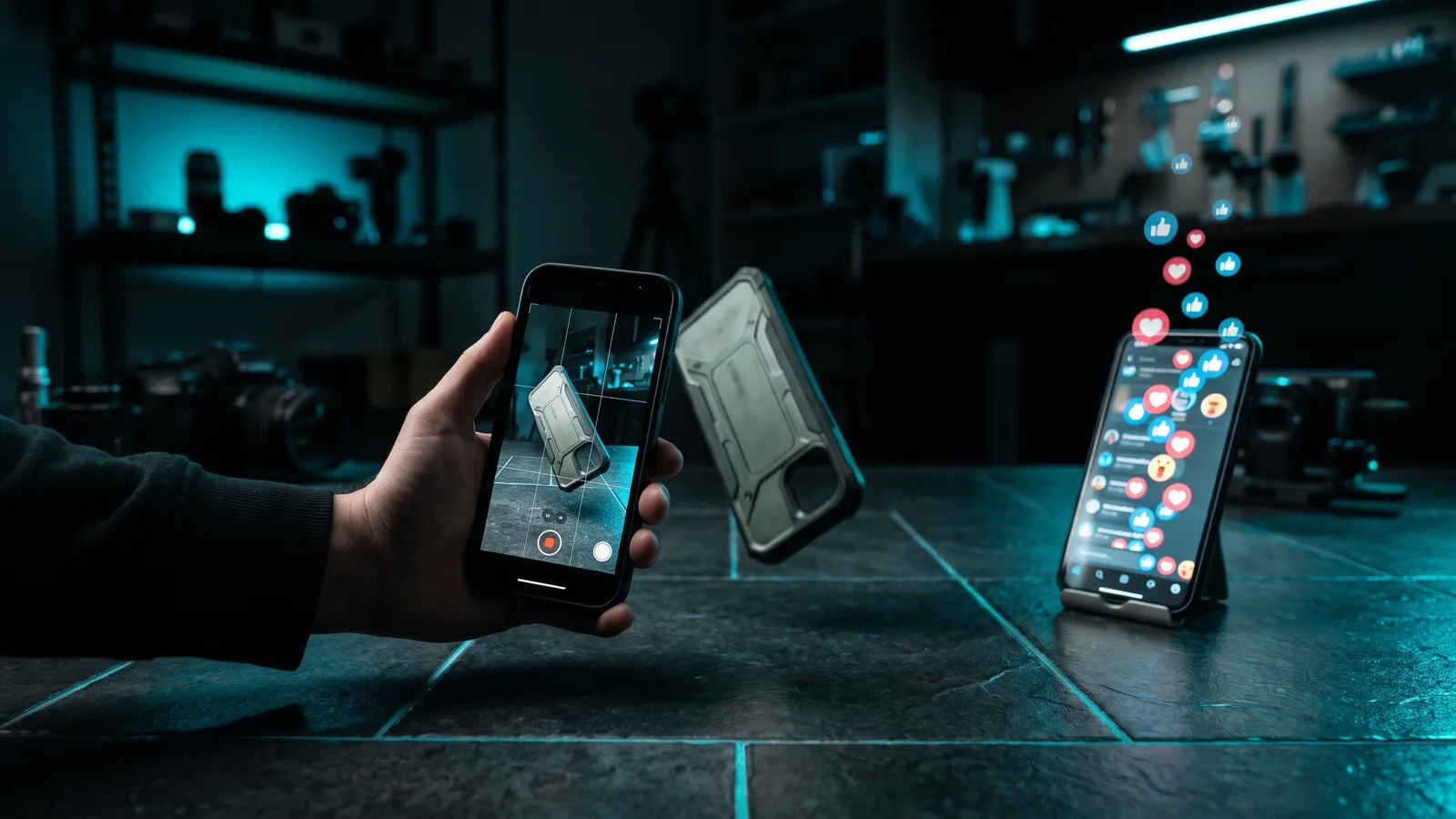
Example concept: A phone-case seller drops a phone from a ladder onto tiles three times, in slow motion. Hook text: "Day 1 of trying to break this case."
2. Problem first
Open on a frustration your customer knows, name it in one line, then let the product fix it fast. TikTok's own TikTok Shop advice is to lead with the pain point and how the product saves time, money or hassle.
Example concept: A lunchbox leaks soup all over a work bag. Cut to the same soup in your leak-proof box, shaken upside down. Nothing spills.
3. Before and after
Show the change on the same object, same angle, no filters. It answers "does it work?" in two seconds.
Example concept: Half a stained grill cleaned with your product, the other half untouched. Hook text: "Left side: 10 seconds with this."
Keep it real. TikTok's ad policy bans ads that reference unrealistic weight loss or muscle gain, or promise a better life from body changes. For any product, only show results you actually got.
4. Satisfying and ASMR
By April 2020, #ASMR had 18.1 billion views on TikTok and #oddlysatisfying had 7.2 billion, as reported by Glossy. Beauty brands like Milk Makeup and Sephora posted clips of tapping containers and squeezing product. Milk Makeup's most-viewed one, skin cream mixed with highlighter with amplified sound, passed 11 million views. That data is older, but the format is still easy to make.
Example concept: No talking. Pour candle wax, peel the film off a screen protector, or pack an order with every rustle and click turned up.
5. Unboxing and first reactions
TikTok lists unboxing, close-ups and creative demos as strong ways to open a product video. Little Moons mochi went viral in 2021 after a Tesco customer posted a TikTok of trying them for the first time. That video got about 300 million views, and sales rose 700%, as reported by Grocery Gazette in July 2022.
Example concept: A real customer (with permission) opens your box. The hook is the reveal, not your logo.
6. UGC-style reviews
UGC means user-generated content: a regular person talking to their phone camera. TikTok recommends real creators, employees or customers and a less polished, DIY look. Meta's Reels research, as reported by Search Engine Land in December 2025, says Reels need "native creative," not repurposed assets.
Sometimes a customer films it for you. In November 2023, a TikTok user posted her burnt-out car after a fire. Her Stanley tumbler survived with ice still inside. The video passed 60 million views, and Stanley's global president, Terence Reilly, replied on TikTok promising her new cups and a replacement vehicle, as reported by ABC7.
Example concept: "I didn't think a $20 pillow would fix my neck. Week two:" Only use real experiences. If you pay a creator or send free product, the FTC says US creators must disclose it in the video itself (on screen and out loud), not just in the description, using clear words like "ad." This isn't legal advice.
7. Humour
In a January 2024 post, TikTok said 30% of users in its 2021 research named humour in creator content as a top reason to buy. Its tip: remix a trend rather than start from scratch.
Dollar Shave Club's March 2012 launch video starred founder Michael Dubin cracking jokes in a warehouse. About 12,000 orders came in within the first 48 hours, as reported by The New York Times in 2013.
Example concept: The founder plays both the "before" customer, fighting a tangled cable drawer, and the calm "after" customer. One benefit, one joke.
What should the first 3 seconds of a product video show?
Show the product or the problem it solves right away. TikTok's creative guide for ads says to land the hook within the first 6 seconds and get the core message across within 3, using suspense, surprise or emotion.
Good openers for products, according to TikTok:
- A close-up, an unboxing or a creative demo
- A question or a relatable line
- A bold claim, or a standout stat like "sold out five times" (only if it's true)
Meta also names three hook styles for Reels, as reported by Social Media Today in December 2025: a value promise, a statement of intent ("I'm going to fix this in 60 seconds"), and a question or invitation. For more examples, see our guide to writing a hook that stops the scroll.
How do you make a viral product video step by step?
Pick one strong moment, show it fast, then test and repeat:
- Pick one product and one moment: the problem it fixes, or the "wow" it creates.
- Choose a format from the seven above.
- Put the product or problem on screen in the first 1–3 seconds.
- Keep one idea per video and pay off the hook.
- Make it native: vertical 9:16, at least 720p, sound on, captions, no other app's watermark.
- Add one clear next step, like a link to the product.
- Make 3–5 clearly different versions. Instagram trial reels let you test on non-followers first.
- Post on a schedule you can keep.
- Read the numbers: completion, shares and comments. Make more of what holds attention.
For the bigger picture beyond products, read how to make a video go viral.
Which tools help you make viral product videos?
Pick based on whether you want ideas and posting handled for you, AI ad variations, or manual control. No tool can make a video go viral. ZippyClip is made by the team behind this blog.
| Tool | Best for | Key features | Price / free option (as of October 2026) | Watch-outs |
|---|---|---|---|---|
| ZippyClip (our pick) | Small businesses that want product videos created and posted on autopilot | URL → video concepts (hook, story, AI visuals and dialogue), captions, scheduling to 5 platforms | Free to start (watermark, 50 API tokens); Pro removes the watermark | Desktop app for Windows and macOS; TikTok publishing is Pro |
| Creatify | Testing many UGC/avatar ad variations | Product URL to video, 1,000+ AI avatars, Batch Mode, A/B testing | Free plan (10 credits, watermark); paid from $10/mo as displayed | Credit-based; tiny free tier; avatar/ad look |
| Topview | Marketplace and TikTok Shop sellers | Link to Video with UGC, unboxing or cinematic styles; editable scenes | No free plan listed (free trial credits mentioned); from $36/mo billed annually | Annual billing only shown; watermark rules not shown |
| CapCut | Editing your own footage into trend-style videos | Trend templates, captions, effects on mobile, desktop and web | Free plan; Pro $19.99/mo | You do the creative and editing work |
Prices change, so check before you buy.
1. ZippyClip — our pick
ZippyClip is our pick because it covers the whole job, not just the edit. Give it your product page or website URL. The AI reads what you sell and turns your products and your customers' problems into video concepts, each with a hook, a story, and AI-generated visuals and dialogue. Then it brings the edit, music and captions together.
You can also tell it what to promote, like a promo showing the problem your product solves. Your existing videos work too.
It also handles posting consistently. You can schedule videos to go out every few hours or daily across YouTube, TikTok, Facebook, Instagram and X. The AI writes titles, descriptions and hashtags for each platform. Smart vertical reframing and word-level captions make each clip fit the feed.
Pricing: ZippyClip is a free download. The free version includes AI content creation and scheduling, with a watermark and 50 API tokens to start. Pro removes the watermark, adds TikTok publishing and makes scheduling unlimited.
2. Creatify
Creatify turns a product URL from stores like Amazon, Etsy or Shopify into avatar-led ads, with Batch Mode and built-in A/B testing. The free plan gives about 2 video ads a month with a watermark. Standard is shown at $10/month (struck through from $15). It's credit-based, and we found no organic scheduling across channels.
3. Topview
Topview's Link to Video takes Amazon, Etsy, Shopify or TikTok Shop links. You pick an audience, a selling point and a style like UGC or unboxing, then edit the script scene by scene. Plus is $36/month billed annually; the pricing page lists no free plan, and we found no publishing feature mentioned.
4. CapCut
CapCut is a hands-on editor with trend templates for humour, before-and-after and satisfying edits. The free plan is usable, and Pro is $19.99/month. The catch: you still come up with the idea, film and edit it yourself.
To start from a product link, see our guide to turning a product page into a video ad.
How many product videos should you post?
Post as often as you can keep up week after week. YouTube says regularity matters most, and TikTok recommends testing 3–5 clearly different creatives at a time. More original videos mean more chances for one to catch on.
Sources
- Berger & Milkman, What Makes Online Content Viral? (Wharton)
- TikTok Newsroom: How TikTok recommends videos
- TikTok: For You feed eligibility standards
- TikTok Ads Help: Creative best practices
- TikTok Business blog: TikTok Shop short video best practice
- TikTok Brainstorm Guide (PDF)
- TikTok Business blog: Why it's important to be funny on TikTok
- TikTok Ads Help: Weight Management and Body Image policy
- Instagram: Ranking explained
- Social Media Today: Instagram algorithm insights (Jan 2025)
- TechCrunch: Instagram trial reels
- YouTube Help: Shorts upload tips
- Website Builder Expert: Meta updates Reels ads guide
- Social Media Today: Meta tips on Reels hooks
- Search Engine Land: Meta native Reels ads
- BYU Y Magazine: Will It Blend?
- ABC7: Stanley tumbler survives car fire
- Grocery Gazette: Little Moons
- Built In LA: Dollar Shave Club, from viral video to real business
- Glossy: ASMR takes over beauty brands' TikTok accounts
- FTC: Disclosures 101 for Social Media Influencers
- Creatify
- Creatify pricing
- Creatify URL to video
- Topview pricing
- Topview Link to Video
- CapCut pricing